Mill Brook Culvert Fix Confounds Island Nonprofits

Updated: May 1

Centuries ago, Mill Brook flowed unimpeded from its headwaters in Chilmark to Tisbury Great Pond, supporting a robust population of native species, which included white perch, herring, Eastern brook trout, and American eels, a staple of Native American diets.
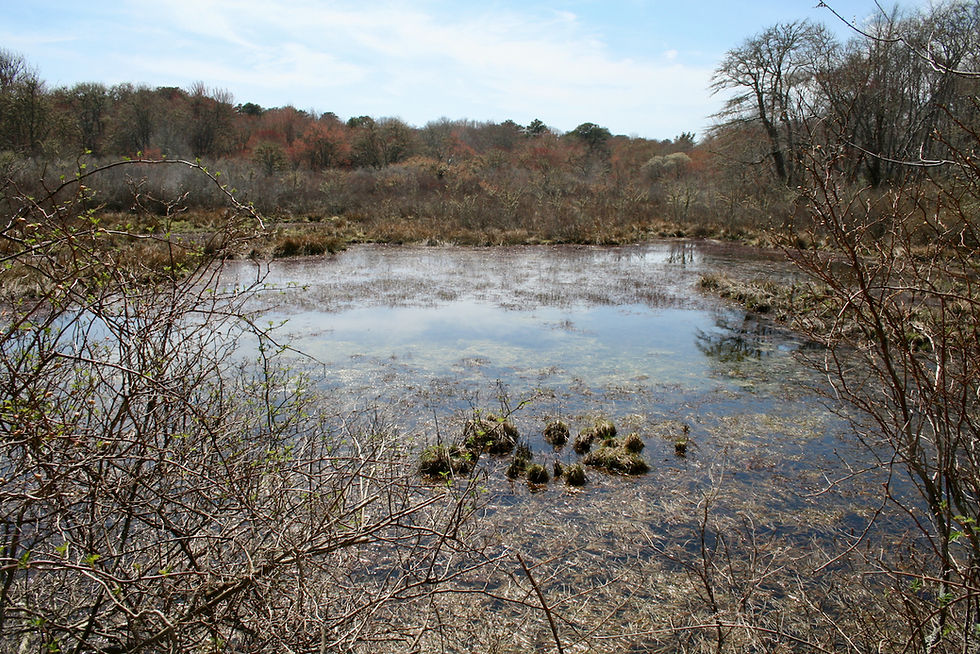
Today, Mill Brook limps along its four-mile length in the heart of Martha’s Vineyard from one dam-created impoundment to another. The obstructions block fish passage and slow the brook’s flow, trapping sediment. In the summer months, the sun heats these shallow pools to harmful temperatures. Taking a human perspective, Mill Brook is a clogged artery in need of significant medical intervention.
Healing the brook — should the Island community agree on a plan — would take time. Removing dams, even obsolete ones, is complex and expensive.

In 2014, the Sheriff’s Meadow Foundation (SMF) envisioned a small step at its 26-acre Roth Woodlands off North Road in Chilmark: replace two improperly sited pipes under Old Farm Road that act as a dam with a box culvert that complies with state stream-crossing standards.
SMF Executive Director Adam Moore had good reasons to be optimistic that the culvert restoration project would be smooth sailing.
The Division of Ecological Restoration (DER) designated it a “Priority Project,” which “supports wetland and river restoration projects that bring significant ecological and community benefits to the Commonwealth.”
At a ceremony in August 2015, SMF received a $40,000 grant from the Massachusetts Environmental Trust and a $7,500 grant from the Daniels Wildlife Trust.
However, twelve years on, despite a plan and significant funding in place, the dam-created pond at the headwaters of the brook continues to warm to over 90 degrees in August, sending heated water into a coldwater ecosystem.
The nonprofit Island Grown Initiative (IGI), the three Dunkl siblings, and land-owning members of the Doyle family are abutters to SMF’s Roth Woodlands. They strenuously opposed the plan, arguing that the environmental benefits of a new culvert were overstated and that removing the impoundment may seriously affect private wells and have serious consequences for the up-Island’s public water supply.
In June 2021, the Chilmark Conservation Commission issued Sheriff’s Meadow a permit. The abutters appealed in Dukes County Superior Court. They lost.
In his 11-page decision dated February 15, 2023, Dukes County Superior Court Judge Mark C. Gildea ruled that the Chilmark conservation commission, “after an extensive hearing process that included the parties’ submission of dueling expert reports as to the effect of the project on nearby private and public wells,” acted properly when it granted Sheriff’s Meadow a permit to replace the culvert.
Undeterred, in 2022, IGI and the Dunkl and Doyle families asked the Department of Environmental Protection (DEP) to issue a superseding order of conditions and overturn the conservation commission's approval. DEP has taken no action on the request.
According to Mr. Moore, DEP would prefer all the parties reach an agreement. As part of that effort, Mr. Moore said, Sheriff’s Meadow paid to test wells on the Doyle property and offered to replace their well “in perpetuity” if, based on the opinion of a hydrologist, the culvert causes it to fail.
Chilmark Spring Water
Frank, Peter, and Heidi Dunkl live in a small cottage on 23 acres adjacent to North Road, between the Martha’s Vineyard Land Bank’s 185-acre Waskosim’s Rock Preservation and the SMF’s Roth Woodlands.
In 1979, the conservation-minded family gave Sheriff’s Meadow a conservation restriction to maintain the entire property “forever in its natural and scenic state” for future generations, and protect the water resources of their property “from any and all activities” which might be detrimental to its quality.
In 1997, the Dunkls formed Mill Brook Springs, Inc., to sell Chilmark Spring Water, taken from a spring on their land. In 2013, the Dunkls put the water business up for sale. (Vineyard Gazette, “Going With the Flow, Dunkl Siblings to Sell Chilmark Spring Water”).
That same year, IGI took ownership of the Dunkl house and property, which sold for $1,459,913 under a life estate that allows the Dunkl siblings to live there until their deaths.
The deed included numerous conditions intended to keep the property undisturbed. These included no use by “persons with unleashed dogs or cats and unsupervised children,” and “protection of the water source that supplies and serves Mill Brook Springs Well and the water resources upon the premises.”
Surprisingly, because there’d been no mention of it previously by IGI officials, in a Sunday, April 28, telephone conversation, Frank Dunkl said, when asked about the ongoing DEP appeal, “I thought we had dropped it.”
Mr. Dunkl said that Sheriff’s Meadow had agreed to dig a new well “where it is possible to ameliorate the situation by digging new wells,” but he stressed, “in our case, with our inactive public water supply, which is a spring water source and is shallow, that is not an option.”
Mr. Dunkl added, “We dropped the opposition, but we warned them, they [SMF] are still liable."
Mr. Dunkl said at 81 and in poor health, he is no longer interested in battling. He said he and his family are planning to move to Virginia.
For the Community
IGI’s involvement in a Chilmark culvert controversy seemed far afield for the nonprofit, based at the old Thimble Farm in Oak Bluffs, that focuses on supporting local farms.
In a story published on July 17, 2013, (“Island Grown Initiative Buys Dunkl Family Land in Chilmark”), the Vineyard Gazette reported that the Island Grown Initiative would buy the Dunkl property to protect the water source. IGI President Sara McKay said the purchase was made possible by “one major donor” who wished to remain anonymous.
At the time, Steve Bernier of Chilmark, owner of Cronig’s Market and an early IGI supporter, was on the IGI board. Ms. McKay managed the market.
In response to a recently emailed series of questions, Mr. Bernier said, IGI didn’t purchase the Dunkl property. “I gifted it to them,” he said.
Mr. Bernier said the existing CR protected the land but not the well. The idea, he said, was to protect access to a certified public well “for the community, forever more.”
Asked about his involvement, Mr. Bernier, who has a reputation for community-minded philanthropy, said, “I hooked up a donor to make this happen, and last minute the donor backed out, I had to step in; That’s all she wrote.”
It Takes Time
More than two years ago, in an interview with the MV Times, “Mill Brook restoration dispute nearing resolution,” Rebecca Haag, outgoing IGI executive director, said the SMF agreement to dig a new well for the Doyles could resolve the issue and allow the project to move forward. “We think it’s going to be resolved, and it’s very close,” Ms. Haag said. “It’s just that all these things take time.”
Since the start of the culvert permitting process, IGI has found itself on the other side not just of Sheriff’s Meadow, but also of Mass Audubon, The Nature Conservancy, Vineyard Conservation Society, and the West Tisbury Conservation Commission, all of whom support the project.

In an April 2021 letter to the Chilmark Conservation Commission, Vineyard Conservation Society executive director Brendan O'Neill said, "The existing earthen dam that divides the Roth Sanctuary wetland was built more than 50 years ago to access the old Edwards Estate. … Your files will reflect that the road was the subject of a major unauthorized repair in July 1991. In the event of undermining in a future storm or the need for another significant repair, we understand that the updated culvert design will be required by the authorities in any case."
IGI had little to say about the DEP appeal or an agreement.
In a recent email reply to a message left on voicemail, Noli Taylor, IGI co-director, declined to comment, citing pending litigation, but said IGI leaders are “aware of the issue and working on it.”
In a recent email response to a voicemail message, IGI board chair Mark Luthringshauser of Vineyard Haven said, “IGI, with the guidance of counsel, is working towards reaching a resolution to the culvert matter that is agreeable to all parties concerned. IGI will withhold any further comment while this process is underway. We will be happy to reach out to you at the appropriate time.”
Not Good Enough
Robert Doyle and members of the Doyle family own two homes on the opposite side of North Road in the exclusive Seven Gates subdivision. As recently as last year, Mr. Moore thought he was close to reaching an agreement with Robert Doyle. He was surprised to learn that they were not as close as he had thought.
Mr. Doyle said that Sheriff’s Meadow's guarantee that a new culvert will not affect his well, and its offer to drill a new well if it does, still fall short.
In a prepared statement, Mr. Doyle said, “We are not against the project. However, we don’t believe that Sheriff’s Meadow Foundation has presented scientific studies that give us confidence that the project will not negatively affect our wells.”
He added, “Nor is Sheriff’s Meadow Foundation willing to guarantee that if our wells are compromised, that they will spend the necessary funds to provide our homes with clean, healthy water. Additionally, we should note that West Tisbury and Chilmark PFAS contamination is a greater and more existential threat to our fish and wildlife than a culvert and the resulting pond that has, for more than 50 years, become its own wonderful ecosystem for birds, frogs, and other wildlife.”
Bill Wilcox of West Tisbury, retired water quality resource planner for the Martha’s Vineyard Commission and a respected member of the Mill Brook Watershed Management Committee, said the Horsley report from 2015 predicts maybe a one-foot drop in water table at a distance of 600-700 feet, which includes the nearest wells. “That should not affect those wells unless they were installed well below standards for well construction,” he said.
He added, “One obvious issue with the impoundment is that the water is heated to an extreme degree by exposing limited flow through to a wide shallow area.”
He said all measurements below the dams on Mill Brook “were indicative of a reduced quality ecosystem when compared with free-flowing, lower-temperature reaches.”

He added, “I'm not sure what Rob sees in the impoundment that leads him to see a wonderful ecosystem, but I think that's doubtful during July and August when the water temperatures are very high. Maybe it's just the lush vegetation.”
Twelve years on, and four years in with the DEP appeal, Adam Moore has reason to feel like an elver trying to slither up the granite, moss-slick face of a Mill Brook dam.


Nice reporting Nelson, and thanks for including that link to the Stream Crossing Standards pdf I took a detour with that for a bit and learned a few things. Hopefully the opposing sides have a defined timetable for resolution.